Sunday, 30 August 2009

The Cheapo TV Spin Off Affair: The Man From U.N.C.L.E. Annual 1969


I was out with my Pater perusing some of the second-hand bookshops along the Charing Cross Road when he pointed out a copy of the 1969 edition of The Man From U.N.C.L.E. Annual, in a dank subterranean basement, for just two quid. This seemed remarkably cheap for the Charing Cross Road. Closer scrutiny of said item revealed that at some stage the cover of the book had either got wet, or some happy child had attempted to burn it, or perhaps both. But not being the kind of fellow who "slabs" my comic books or won't open up a paperback for fear of cracking the spine, it didn't matter to me. I snapped it up.

On the cover you can see the stars of the show: U.N.C.L.E. secret agents Napoleon Solo (Robert Vaughan) and Illya Kuryakin (David McCallum), with their boss, Mr Waverly (Leo G. Carroll) peering crustily over the book title. I can almost hear him gruffly mumbling "Open Channel D! Come in, Mr Solo!"

I love the Man From U.N.C.L.E. series. Growing up in the 1970s-1980s, I was too young to have seen the TV shows the first time round, but the feature films (which collected together two-part episodes from the original series) were regularly seen on Sunday afternoon telly. It was an excellent tongue-in-cheek spy show made in the shadow of the James Bond movies, and though I was a kid I could immediately detect that it was funnier, more absurd and less self-important, in the same way that Fawcett's Captain Marvel was always more fun than DC's Superman.

Besides this, Napoleon Solo (suavely played by the brilliant Vaughn) was responsible for what became my obsession with what is now known as "retro" clothing (back then it was out of date clobber that you gave to jumble sales). I spent much of the 1970s clad in hand-me-downs from various folks who lived up and down the street (I had a happy childhood, and never went without, but times were tighter back in those days!) - and for a brief time I was unfortunately compelled to wear a particularly awful pair of tartan flares with golden buttons (adorned with anchor designs) down the legs, to emphasise the flare (which, believe me, didn't need emphasising). I was not best pleased. Already yearning for the days when I could choose my own attire, I was awestruck by the sharp style of clean-cut Solo's splendid 1960s suits and narrow ties. He was so cool! But I had no idea then that he was wearing the fashions of a past decade.


Ironically, I had chosen to focus on the old-school "square" of the programme's duo of leading men - for it was his supposedly Eastern bloc spy-colleague Illya Kuryakin (splendidly played by Brit David McCallum) who was supposed to be the the stylish "swinger" of the show, with his gear Beatles mop-top, groovy black polo-neck jumpers and shades. Anyhow, at the time, I didn't care about that, I wanted a suit like Napoleon Solo's. I still do. But, funnily enough, they don't turn up in the charity shops very often. Incidentally, I do now own a couple of sixties suits (one of which, I'm proud to say, I acquired from a charity shop bargain rail for just a quid. It is known as The One Pound Suit). I wore one to my University graduation in 1993, in fact, with a vintage triangular U.N.C.L.E. badge on the lapel (hidden by my graduation gown), which might give you some idea exactly what kind of a man I am. But, as usual, I digress. What of The Man From U.N.C.L.E. Annual?

It's easy to forget, in these fanboy-friendly modern times we live in, that adult devotees of TV shows were not always so well-served in terms of collectible ephemera and spin-off product. Kids' shows were kids' shows. Nobody had a video recorder back then and you were expected to watch a TV show once, half watch the repeat, then forget it. Collectors' DVD box-sets weren't even thought of. Tie-in products - like this annual - were fewer and further between (though U.N.C.L.E. fared better in this regard than many shows of its period, with plenty of magazines and paperbacks) and many such items were generally uninspired, quickly knocked-up cash-ins, designed to be peddled to parents to give to the kiddies on Christmas morning. This annual was meant to be looked at rather than read, scribbled on, made soggy, dried in an airing cupboard perhaps, burnt around the edges, left lying about for a year or two, then thrown away. It was definitely not designed for kooky adults (like our good selves, dear readers) to hoard, wax lyrical about, store in a plastic sleeve, or subject to close analysis. Paradoxically, part of the substantial charm of these hastily-prepared artefacts lies precisely in their weaknesses - the throwaway nature of their production, their unpretentious bargain-basement design, the strange absurdity of their thrown-together content. All these factors help make them fascinating (and highly entertaining, if you are a connoisseur of all things trashy) keepsakes of less pop-culturally aware times, times never to be seen again.

So, what do we have here? All the stuff you always got in these annuals. Reprints of American comic strips - which, as was often the case, were the high point. In this case, these were taken from the Gold Key U.N.C.L.E. comic, which bit the dust in 1969. How can you go wrong with this one, featuring a giant kangaroo, who's also an agent for nefarious spy organisation T.H.R.U.S.H.:


The kangaroo has even developed the villainous scowl of a sinister secret agent. You'll note that the writer and the illustrator have cottoned on to the fact that they can do stuff in a strip that might be a little trickier to stage on TV, and they can do it in lurid day-glo colours, to boot. The strip also features a snake and an eagle, two more mean-looking animal agents for T.H.R.U.S.H. You can't knock the ambition of this tale, even if Napoleon and Illya don't quite look themselves (Solo even seems to have developed a stutter) and the kangaroo looks a bit ratty. I must keep an eye out for some of the Gold Key issues...

A nice surprise was this crazy back-up strip featuring foxy biker chicks...

Is it just me, or has the artist copied that car - at that angle - straight from the Zapruder film? If only JFK had had the "beautiful femmes fatales" Stunt Girl Counterspies to protect him. "Good work, Petite...but make sure your shots don't endanger the crowd!" cautions Jet. Useful advice in those tricky firing-your-gun-in-crowded-areas-whilst-riding-a-motorbike situations. Whatta gal.

The problem is, it seems that the publishers of the annual only licensed one comic-book's worth of American strip content. Which meant that the filler-factor was at maximum. As the tightwads who cobbled the book together also didn't cough up for any photos from the programme apart from the ones on the cover, there is an abundant bounty of awful text stories, incredible illustrations of the cast that don't look like the people they ought to look like, and bizarre, unintentionally hilarious filler pages. Imagine getting the gig to write all this stuff. Or to do the illustrations. No-one was ever expected to read it. And no-one cared. It didn't matter in the slightest how it looked, as long as it was done quickly. All of which is highly entertaining in a dreadful sort of way.

The American-ness of the show collides with the British-ness of the cheapo kids' annual on pages like Spy Catchers, which would be more at home in a DC Thompson weekly war comic like The Victor. I include it here for your delectation and delight.


Hmm. The U.N.C.L.E. logo and the title, Spy Catchers. Sounds pretty exciting - I bet it's about the villains that Napoleon and Illya face, right?

Wrong. It's about the Great British Bobby, in the Second World War. What do you think this is, the Man From U.N.C.L.E. Annual or something? Now forget all about those absurd American chappies, and pay attention. You might learn something. See the police officer use his initiative here, wisely arresting anybody with a moustache and a gaunt visage who looks at a signpost in the street. Sentence: death.

'Ello, 'ello, 'ello. What do we 'ave 'ere, then? The rozzers mop up another Nazi "wearing the disguise of a travelling salesman". Maybe sticking around with that suitcase full of toothbrushes in the immediate vicinity of his 'chute wasn't such a good idea after all. But even spies have to peddle their wares somewhere...

Ah, himmel! I knew I forgot something! Addendum to next edition of German spies' handbook: after burying parachute, adopting the disguise of a travelling salesman, and stroking chin beneath signpost, remove all German sausage from suitcase. Especially if it's gone green, you might have had it for too long. Sentence: death.

Enough already with the travelling salesman. What else do we have on file to fill the remaining two panels? Ah yes, a true but non-specific tale of the Scottish coast, in 1940. Don't splash my pencil skirt, you dumpkopf!

I arrest you for having sopping wet feet on a dry morning. No excuses. And also for wearing 1960s suits in 1940. And, come to think of it, having three legs is suspicious, too. Sentence: death.

There's also a charming but rubbish board game. Imagine the misery of playing this with an actual Uncle on a wet Sunday afternoon...

The Kiddies: Please, please, Uncle Peter, can we play THE SELECTA AFFAIR board game?


[some hours later]...Uncle Peter, pay attention, you're not playing seriously!


Uncle Peter: Nearly hit by a car? Why couldn't it be actually hit by a car? God, this is dull.


Sod this, kids. Play by yourselves, now. The pubs are open. [Exeunt.]
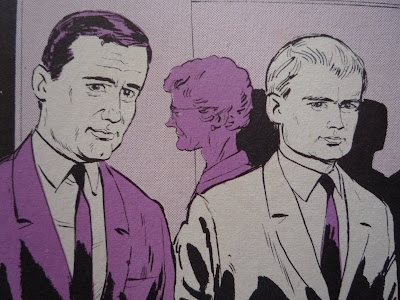
Splendid stuff. And as for those written stories, well, as you'd expect, knowing my track record, I couldn't get through them, but there are some superbly weird illustrations.


I'm made vaguely uneasy by the vest and Y-fronts combo going on there. I know I shouldn't be, but there's just something about it I don't like. This picture would have given me nightmares as a child. What was going through the artist's mind as he drew this? What was his brief? "Depict unconscious man in background, dressed in vest, white Y-front underpants, socks and shoes."

Look at the strange woman in this next one:

Illya, why are you harassing me with your child-woman blow-up doll? Not that it looks much like Illya, to be honest. It would seem that the main problem the artist faced here, as in all annuals of this kind, was trying to make the illustrations look like the people you'd seen on TV...


Illya? Is that you, Illya? Or a cabbage patch doll? And what happened to my face?


Illya? Illya? Is that you? Or a robot? No bananas for me, thank you.


Would you like a sweetie, little girl? Illya??


Illya? What happened to your hair? How come it's growing out of your forehead?


Illya? You've aged. And yellow's just not your colour.

All of which might give the impression that I didn't enjoy reading the 1969 Man From U.N.C.L.E. Annual. On the contrary, I enjoyed it very much. You will find this annual in THE HOUSE OF COBWEBS. Open Channel D.

Wednesday, 5 August 2009

"It's the most worthless thing I ever saw!" Pudgy Pig and other annoying animals


And now, chums, the long-awaited second in my occasional series of posts devoted to the detailed (and entirely pointless) assessment and analysis of the dismallest, lamest, what-were-they-thinking-est, dustheap-of history-est comics of all time (which, oddly enough, are all qualities which seem to compel me to purchase them and gather them together).

I was at the London Comic Mart on Sunday, shuffling quietly amongst my seedy, aromatic, vaguely embarrassed child-man brother-collectors, when I came upon Pudgy Pig. Though the issue is numbered Number 1, Volume 1, I can't imagine that anybody genuinely believed they would ever need to put an order in for a leather binder (proudly embossed, perhaps, with Pudgy Pig Volume I in gold leaf on the spine). Even the least critical kid would surely have spurned this publication, and it would seem they did: the 'volume' ended with Number 2.

The signs couldn't have been good for any comics-savvy prospective purchaser, back in September 1958 - it's a Charlton Publication, for a start, and you know what that means - but to the purveyor of all things odd, obscure and culturally bereft, it has a certain desperate something that is hard to resist. Take a look at that splendidly idiotic cover. Did you ever see such a blank-faced and emotionlessly conceived porcine hero? Blatantly and specifically designed to rip off Dell's successful Porky Pig comic book, this was surely a magazine created for one purpose, and one purpose only: to be purchased by mistake by a parent in a hurry or a half-blind grand-mama.

They didn't even bother to be consistent. As you can see from the cover, Pudgy sports a ridiculous Donald Duck-esque sailor hat, to disguise his exceedingly Porky Pig-esque coat and bow-tie. Perhaps the headgear was an attempt by the chaps at Charlton to deter the Warner Bros. lawyers from paying a visit. Intriguingly, by page 3, Pudgy has had a complete make-over, and sports instead a distinctly unPorky-like red jersey with a 'P' on it. Perhaps WB's lawyers did see the cover and did pay a visit.


Gone is the jacket and bow-tie. But his new outfit doesn't do him any favours. In fact, he doesn't even look like the same pig. That jersey fits where it touches, and Pudgy seems to have aged somewhat and put on a considerable amount of bacon around his somehow vaguely distasteful hips. Most disconcerting. No wonder his girlfriend favours Packing-House Pig III; by comparison, the rich fop seems to have sleek, snake hips, if such a thing is possible for porkers.

The stories are bewildering; I couldn't make much sense of them. It was like they were never intended to be read. Particularly the weird highlight of the issue, It's a Trade, which seems to have been written by an out-of-work absurdist playwright.


Gee whiz, there's an old boat full of holes at the bottom! I wonder if it's any good? Hmm, that's a tricky question. It's a boat, but it is full of holes at the bottom. And stop jumping around turning your head in three directions at once (none of which would allow you to see the boat you seem to know so much about). Anyway, here's the answer:

It's horrible! Calm down, Pudgy Pig, it's only a boat with holes in the bottom! A simple "no, it's not any good" would do. But Pudgy is kinda extreme, claiming that it is the most worthless thing I ever saw. You reckon? Taken a look in the mirror lately, Pudgy?

That's enough of that. Also in this bumper fun package, Pudgy gets erstwhile support from Atomic Bunny (not at all reminiscent of Fawcett's Marvel Bunny), who features in his own story, of a similarly high standard.


Mmm, delicious irradiated vegetables. And as Atomic Bunny is such a great, original idea, why not have Atomic Mouse (not at all reminiscent of Paul Terry's Mighty Mouse), too? You can't steal too much of a good thing, eh? Flip a few pages, and you'll come across this -


Erm...daily habits, Atomic Mouse? What kind of 'Fun with Pop' daily habits? Should I call Social Services?


Oh, those kind of daily habits. You mean if I do my exercises, I'll grow up to look as good as pudgy-cueball Pop? Maybe I'll just stay in bed after all. Reading Pudgy Pig comics.

But seriously folks, Atomic Mouse even does charitable work for the community. A whole page is devoted to this important public service announcement to the nation's youth, as part of the Fun With Pop scheme. What do you mean you've never heard of the Fun With Pop scheme? You been living under a rock or something, pal?


Poor Charlton. Whereas their hi-tone competitors (DC, et al) were actually sponsored to publish genuine sanctimonious governmental advert pages to brainwash the nation's youth, it looks like our pals at Charlton had to make up a nebulous, wholesome scheme of their own to get in on the act, complete with an official-looking logo, accidentally-on-purpose printed in a smudgy, indistinct fashion, I suspect, to hide the fact that there was no official endorsement of the initiative by anybody at all other than the hacks in the Charlton editorial office.


Well, at least the Pop in the logo has some hair. And doesn't wander about in his vest all day.


All very wholesome. But supposing you're not able to go out for 'Fun with Pop'? Supposing 'Pop' is an alcoholic, or something? What then? The next page has the answer. A horrible and unusual gift in a box.


Or, in keeping with the cheery atomic theme, how about this?


Just like an A-Bomb. I'm glad to hear it. Anything less would be rather a disappointment.

And once you've stolen 20 cents from Pop's wallet to pay for your A-Bomb, flick over another page and there's a ghastly written story, Annoyed Animals, which, once I'd detected that the words 'happy zoo' were included, I certainly didn't bother to read.


But the "illustration" is in another league entirely - definitely worth a look.


A masterpiece of stylised ineptitude, you have to admire the total lack of care taken over its execution: it looks like the 'artist' had a quick go at a couple of 'annoyed animals', did them a bit wrong, then drew funny lines over his mistakes. And shoved in a tree and a moon, because they're easier to do. Except the moon went a bit funny and looks a bit like a banana. A superb piece.

All in all, another Charlton classic. And which gifted comics-auteur came up with Pudgy Pig, I hear you cry? Sadly, we'll never know for sure, but perhaps there is a clue on the cover: the proud, prominent signatures of the cover artists (and creators?) of Pudgy Pig.


Yes, dear reader, one of these names is already familiar to the ever-growing legion of discerning readers who follow this blog: D'Agostino.

Could it be Jon D'Agostino, the key figure behind Charlton Comics' Freddy? Do I detect the hand of the master?

You might find this comic in THE HOUSE OF COBWEBS. Or I might shred it. I just don't know.

Sunday, 19 July 2009

Reading old 'funny animal' comics: a sure way to get people to give you funny looks on trains and buses


Greetings, chums. If you would be so good as to indulge a mad old man I thought I might mention some undeniably good comics today. I'm rather a fan of vintage 'funny animal' comic books, particularly those that feature Donald Duck written and drawn by 'the good duck artist' Carl Barks or Mickey Mouse drawn by Floyd Gottfredson. But in all the decades of my lonely existence I have never met anybody - in the flesh - who really shares my love of this particularly unsung avenue of the obsolescent, the old and the nerdy. Even friends who like comics - and I have one or two, believe it or not - who, reassured by the recent adult acceptance of superheroes as in some way cuturally valid, would be quite prepared to spend an all-too-rare evening in the pub discussing how many different kinds of kryptonite there are, or whether Super-Horse or Beppo the Super-Monkey was the stupidest idea for a super-animal, nonetheless perceive 'funny animal' comics as infantile, ridiculous, and the most obvious symptom of my antisocial sickness. In fact, they can barely conceal their disdain for me, when, with a nervous laugh, I casually attempt to drop a topic like Super Duck, the lederhosen-clad Donald rip-off of the 1940s (who had a strangely attractive, albeit duck-headed, girlfriend), into the conversation.

So, many years ago, searching for informed discussion and intelligent debate on weighty issues such as this, and when I was younger and even more idiotic than I am now, I joined a Disney comics "discussion group". Super-Duck was not mentioned there, of course (even less people care about him than care about Donald) but I hoped to engage other like-minded fellows in some cheery 'funny-animal' related wrangling on topics of mutual interest. It has to be said that in the main the experience was a grisly one. Many messages had been written by people (all men, of course) who seemed quite clearly to believe that Donald Duck, Uncle Scrooge, et al, were real, and that comic strips about them were little more than transcribed excerpts from their personal biographies; and that if you could manage to ignore the superfluous irritation that these strips contained an entertaining narrative, jokes, and that sort of thing, they might at least contain useful statistical data which would enable you to calculate the exact size of Scrooge McDuck's Money Bin in square feet, or to ascertain in precisely which year he first wore a top-hat. The fact that Carl Barks, writer and illustrator of these tales, had no interest at all in such considerations, meant nothing to the feverishly enthusiastic chaps on the message-board. In addition, in other free moments, when not engaged in such matters as isolating the strictly correct permuations of the convict-numbers written on the fronts of the villainous Beagle Boys' jerseys, many of these chaps would write in the group to tell a more recent writer of Duck strips, also a member of that group, who shall remain nameless, but who is rather highly regarded these days, (perhaps precisely because he is obsessively interested in all that kind of boring fan-boy duck data) how very wonderful he was, and how very wonderful it was that he devoted his valuable time to reading their unworthy messages filled with their glowing praise, lavished upon him endlessly, like a cascade of oily gold. Which, to me, all seemed rather sickening.

Foolish dolt that I am, I could not contain myself. Unwisely, I immediately wrote in to the group with a comment to the effect that I didn't give a stuff how big McDuck's money bin was, and Barks wouldn't have done either; and that I didn't think the new stories could hold much of a candle to the old ones, to boot. After merely being ignored for the preceding years, suddenly I found myself somewhat towards the centre of attention, as I was savagely lambasted for my sacrilege. Suffice to say I did not write in again.

But I digress. What I was trying to say was that I don't get much of a chance to actually share the delights of old Disney comics with anybody, hence I am writing about them here for my massive internet readership. Let me make it clear, I'm being quite specific about this. I don't just like every Disney comic strip, they have to be by the decent writers and artists, who transcended the limitations of writing about characters that, by the 1940s, were already coagulating into corporate ciphers, little more than advertising images for the mass-marketing of American pop-culture. But beneath Uncle Walt's radar, under-paid artists like Barks and Gottfredson were not telling stories of ducks and mice, they were telling stories of hard-up everymen, who just happened to have animal heads. If you've never tried them, you should. I recently picked up a whole batch of early issues of Walt Disney's Comics and Stories from way back in the 1940s, from an ebay seller in the states.

The issues themselves are what you might call a curate's egg. They always get off to a cracking start with a Carl Barks Donald Duck ten-pager (unlike most of the geeks who I upset all those years ago, I prefer Barks' comedy shorts to the long Scrooge adventure tales). The best of Barks' work stands up against anything in American popular literature, I reckon - it is simultaneously funny, sad, bitter, life-affirming, truthful, bizarre, and massively cynical. And somehow, thanks to Mr. Barks, a weird duck in a sailor suit becomes an everyman who can make me laugh. Check out the page below that I have attempted to upload for you in my usual ramshackle way.


This is from Walt Disney's Comics and Stories 89, February 1948. I think this page alone is a work of genius. I believe Barks has included a self-portrait, depicting himself as the battered boxer halfway down the page.

Not only do you get this brilliantly funny "interior monologue" character stuff with great visual gags, Barks also sticks in screwball craziness whenever he feels like it. Having got the job as a night watchman, Donald must attempt to stay awake until he clocks on... hence the following...


Isn't it terrific? A little later he tries a spot of dancing...


For me, the first panel above has more potency than a six-month prescription of antidepressants...

Anyhow, enough about Barks, for now. As well as top-quality stuff like this, you also get filler. Drippy kiddie stuff. There's the tedious slum-dwelling insect Bucky Bug (out of focus, below, like a half remembered nightmare), for example...


Incidentally, as a rule of thumb, any comic strip written in rhyme (and this goes for all comic strips, in the world, ever) is not worth reading and is best skipped over (in certain cases, best destroyed). For some reason, somebody somewhere at some time decided that the kiddies gleefully delight in text written in rhyme, no matter how rubbishly it has been concocted. Invariably painfully knocked-up to order by miserable half-drunk hacks, compelled to tell contrived stories in rhyming 'poetry' they do not feel any desire to write (and more difficult to cobble together than straight sentences, goddammit), efforts of this sort are always painfully infantile, tedious and - literally, in this case - lousy.

Another rule of thumb: Chip 'n' Dale: AVOID AT ALL COSTS. E.g.:


And it's in rhyme. The evil chubby-cheeked little shits. I hope Donald has a rifle.

Instead, spend some time digging Gottfredson's fantastic Mickey Mouse - another highlight of early issues of Walt Disney's Comics and Stories. Take a look at this brilliantly drawn sequence from issue 89, February 1948(written by Bob Karp and Dick Shaw), featuring Goofy's pet lion, Agnes....


And the splendid strip below is from issue 77 (February 1947), and was written by Bill Walsh...a great example of how down-at-heel Mickey (and Donald) were before they got cleaned up and middle-class-ified a few years later...

I love the weird pre-comics code funny-animal world, where it is entirely normal for a libidinous giant mouse, in slacks and a Leo Gorcey hat, to attempt to make some time with a haughty human gal, only to be served with an eviction notice.

The looming spectre of adult sexuality within the 'innocent' funny animal kiddie universe of these years never fails to fascinate me. Which leads me on to another highlight of these comics: short Donald Duck strips (reprinted from newspapers) by Al Taliaferro. His Donald is often tempted away from Daisy by other, more shapely, more human, dames...


Who can blame Donald for winking at that curvy gal, eh? After all, Daisy is a duck! But, erm, hang on a tick - so is Donald. I forgot for a moment. Also, Don seems to be wearing more in the trouser department when he's on the beach than he does at home. I'm confused. As usual.

Don't be afraid. You know you want to try some of this stuff. It's brilliant, really funny, I guarantee it. You just need to get the right stuff, the old stuff, by the good writers and artists. Start with a cheap reprint volume of Barks. And be prepared for the funny looks you'll get if you read this stuff on the bus to work. Perhaps slip your Donald Duck inside your copy of The Economist?

You'll find a growing stack of these comics in THE HOUSE OF COBWEBS.

Saturday, 4 July 2009

"Bagged...in a giant unbreakable plastic net!" Blackhawk, No. 189, October 1963


This copy of the DC comic Blackhawk, salvaged from an Oxfam shop in Reading, clip-cornered, and with '6d' scrawled in biro across it, has been through the wars a bit. As had the Blackhawk characters by this stage: October 1963. They had started off decades previously as WWII 'Air Ace' fighter pilots of different nations, but by the 1960s the kiddies weren't interested in that sort of thing any more. As we know from one of my previous posts, the flower children were more interested in reading about wacky teens, skin-head wigs and feeding lollipops to little monkeys.

So, what were the editors to do with Blackhawk? The answer was obvious. Keep the good bits - the fetching leather gear, and the national stereotypes (a useful aid - along with hair colour and moustaches - in differentiating between a large cast of virtually identical airmen in matching outfits) and get rid of the bad bits - like all those pointless, boring aeroplanes (whose crazy idea was it to have those?) - leaving the team do what they were best suited for: sci-fi crime investigation.
But if they were going to do a revamp, why couldn't the little guy with the Mr Spock haircut (prominent on the cover, but with no "lines" inside) have a leather suit like his pals?

Meanwhile, though the Blackhawks had been grounded, The Super Cavemen of 15,000 B.C. had taken to the skies. Any discussion of the plot would of course be both tedious and fruitless: this comic was sold entirely on this cover concept. Why do you think I bought it? But I must say that the story inside is a weighty, ambitious piece, about the theft of futuristic devices, which have been dispersed by villainous aliens into ancient times, in three "chapters". Indeed, so weighty was it that I fell asleep on two consecutive evenings before I had reached Chapter 3, The War With Super Weapons. I usually only do that with 1960s Superman stories - particularly those that feature guff about the bottle city of Kandor, tedious Kryptonians with names ending in "-El", or "Imaginary Stories" (gosh, you mean they're not real? zzzz), or Nightwing and Flamebird, whoever the hell they are. Or anything at all featuring The Legion of Super Heroes.

Though I love 'em, and this issue of Blackhawk is actually pretty good fun (if you stick with it and can remain conscious long enough to reach the end) it reminded me that DC Comics were the absolute masters of po-faced tedious pseudo-scientific snore-content, and it was at its height in the early to mid 1960s. God, some of their stuff was dull. Anyway, here we get a glimpse at ze cavemen's camp (and ze camp Blackhawks, non?) as our heroes are imprisoned in "unbreakable" plastic.


But, Himmel, did I mention the fact that the team also visit ancient Rome? Well, they do, and here the 'national phrases' are a useful aid in distinguishing your Olafs from your Andres. But, Himmel? Eh?


And where did they get those togas, I don't hear you ask? Well, they might have built the Colloseum, but you can bet your bottom US dollar that a trusty American Zippo lighter will turn those Romans straight into bewildered red-skins...


Do they find all the "super devices"? That would be telling, py yiminy! I wouldn't dream of spoiling the ending. But though he is surrounded by "ultra-modern" gadetry throughout, and has a quick go on the jet-powered skis to wrap everything up, poor old Blackhawk, trapped somewhere on Mid-Sixties DC Earth, can't for the life of him seem to find his aeroplane.

But, Himmel, you will find zis comic in THE HOUSE OF COBWEBS.

Sunday, 7 June 2009

"Dismiss these absurd follies from your mind!" The Stage-Struck Schoolboy and Miss Kitty Skitty (The Gem, No. 237, August 24th, 1912)


Greetings, dear reader. Today, let's forget all about that clod Freddy. May I invite you to step aboard my pop-culture time machine? We're going back a long way - back to the days of Empire, back before the First World War, back to England, August 1912. Never such innocence... Here we will pick up a copy of the popular weekly story-paper, The Gem -  issue 237 to be precise. It'll cost you 1d. in the old money.

The Gem was the companion paper to The Magnet. Both had, by then, for some years been published weekly; they were not comics: both featured lengthy written stories of fictional 'public schools'. The Gem came first, in 1907, and featured Tom Merry and Co. of St. Jim's;  The Magnet began shortly afterwards, in 1908, and featured Harry Wharton and Co. of Greyfriars, as well as a splendid obtuse bespectacled check-trouser wearing fat-boy character called Billy Bunter, perhaps even now, 100 years later, still dimly visible on the 'enduring fictional characters' radar. But probably any moment bound to slip off. 

No young folks remember either paper now, of course, and the idea of buying a magazine that just featured column after column of type-set prose fiction, with just the occasional illustration, would probably strike them as utterly bizarre, and laughable. Which is their loss. 

Greyfriars and St. Jim's were the creation of a highly prolific writer named Charles Hamilton (aka Frank Richards, Martin Clifford, and umpteen other pen-names). Not a public schoolboy himself, he went at his writing with Dickensian aplomb, hacking them out at his typewriter, but writing in a beautifully clear style, churning out thousands of stories for loads of publications for decades.  He created a truly fantastic, concise, yet clearly-defined imaginary world of high comedy and gripping drama amidst the ivy-clad cloisters, and somehow breathed life into massive casts of great characters, both pupils and teachers. None of this (thankfully) can have borne much resemblance to the elitist world of real public school life, but rather represented his considerably more democratic idea of how it ought to have been. Forget your J.K. Rowlings, this is the real deal. And, to a crackpot like me, at least, though it is supposedly based in 'reality' and set in a school, Hamilton's strange fictional universe is just as fantastically other-worldly, just as coherent, and just as meticulously realised, but a million times more entertaining than anything Tolkien ever dreamed up in his dreary footnote-riddled way. 

Hamilton's work, though liberal in its overall outlook, is very much a product of its time, of course, and is full of ideas, expressions, and stereotypes that might seem outrageous today, but that's part of the fun, isn't it? And let us never forget to consider the context and the times in which an artefact was produced when we appreciate all things old. Incidentally, such issues have plagued the discussion - and honest enjoyment - of Hamilton's work for decades - as can be seen in this cartoon from 1970, reprinted in a Giles collection I found in the charity shop for £1 yesterday....


Anyhow, enough of all that. Principally, I wanted to share a few dramatic moments, and the superb illustrations from this copy of The Gem, with you. Recounted in this issue was a strange, slightly melancholy tale of Tom Merry's pal, Monty Lowther. Infatuated with actress Miss Kitty Skitty, he decides to run away from school and join the theatre company with which she performs.     

Above we see Monty, wearing a rather fine topper, shamefully sneaking into a theatre, to ogle Miss Kitty. 

Yes, he's stage struck, and, we discover, he's covered the walls of his study back at school with "theatrical pictures and photographs". His Headmaster, Dr. Holmes, sternly demands that he take down the "absurd photographs", and orders him to burn them immediately. I'm with Dr. Holmes - you can clearly see the lady's ankles in one of those pictures. Disgraceful.


"Take down those absurd photographs from the walls, Lowther!" said the Head, sternly. Lowther hesitated. But there was nothing for it to obey. Dr. Holmes stood frowning, while Lowther pulled down the offending theatrical photographs. "And now put them in the grate and set fire to them!" said the Head. (See Chap. 5). 

Lowther is undeterred, however, and ends up doing a bunk, to get his chance to tread the boards. He gets swizzled out of his post-office savings by an boozy, unscrupulous thespian, but does manage, finally, to make his debut with Miss Kitty. However, just as they go giddily into the opening chorus of "The Counter Girl Waltz", and they begin to skip gaily about the stage, Dr. Holmes arrives to turn his dreams to dust. I must say, the old gentleman does not look especially impressed by Lowther's effete behaviour.


At least, in the background, the stagehand's having a good laugh at it all...


Dr Holmes takes Lowther back to school, and orders him to "dismiss these absurd follies from your mind". A wise lesson for us all. Never allow the siren lure of musical theatre, or Miss Kitty Skitty's ankles, to distract you from the quiet, contemplative world of academic study. I have always lived by this maxim.

I didn't read the back up story, The School Under Canvas, a story of Gordon Gay and Co. (another Hamilton creation, I believe), because it was part of a serial (modestly billed as the most exciting school serial ever written, in fact), but the introductory illustration of good-old fashioned school discipline might serve as a useful reminder of how we have taken the wrong turn with our modern, liberal educational methods.

The German master strode savagely towards Gordon Gay and grasped him by the collar. "Mein papers!" he hissed. "Give dem to me, or---" And in his blind rage his hands closed in a grip like a vice upon the throat of the Cornstalk junior. (See p.23). 

You will find this story-paper (temporarily - I borrowed it) in THE HOUSE OF COBWEBS.